Date: Saturday, 28 February 2026
Time: 4.00PM – 6.00PM
Location: New Bahru School Hall
Conceived as the closing event of TAF’s inaugural exhibition Rituals of Perception, this iteration of the TAF Conversation Series features a newly commissioned performance by Carolina Fusilier in collaboration with musician Fumitake Tamura, followed by a conversation between Fusilier and artist Stephanie Comilang, moderated by Xiaoyu Weng, TAF’s Artistic Director. The program marks the culmination of TAF’s year-long research on materiality, focusing on how contemporary artists engage the entanglement of material, technological, and embodied systems.
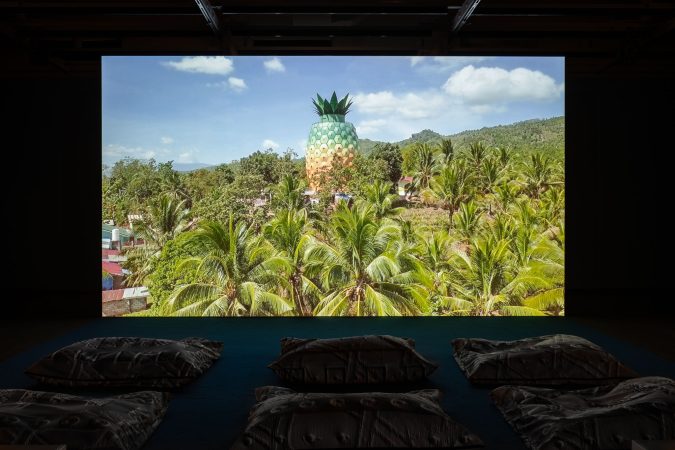
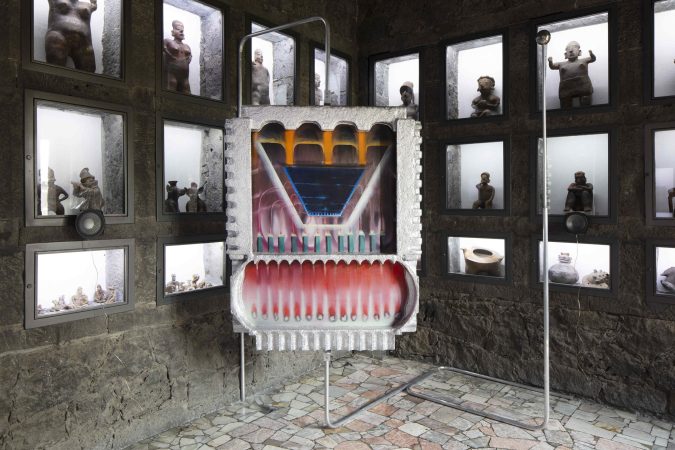
Developed as an extension of Fusilier’s installation Inmortalistas (2025) and conceived specifically for the New Bahru School Hall, the performance Attuning to Sonic Residue centers on a handcrafted device designed to capture radio waves and electromagnetic frequencies, integrated into a wearable suit. Emitted in real time through a speaker embedded in the costume, the sound transforms the performer’s body—and the surrounding artworks—into living antennae capable of receiving and amplifying invisible signals. The work frames the body as a technological interface, rendering perceptible the constant exchanges between bodies, architecture, and technological systems, and positioning active listening as a ritual practice. Approaching radio and technology from a narrative perspective, Comilang’s video work Piña, Why Is the Sky Blue? (2021), created with Simon Speiser, unfolds through the voice of Piña, a sentient AI shaped by ancestral knowledge. The work interweaves the stories of Amazonian women radio broadcasters, Afro-Ecuadorian and Indigenous healers, and Filipina spiritual leaders, whose memories and ritual knowledge are “uploaded” into artificial consciousness.
About TAF Conversation Series
Developed to manifest the foundation’s process-based and research-driven programming, TAF Conversation Series engages artists and their collaborators to respond, reflect, and shape TAF’s research concerns. Intently blurring the line between the work-in-progress and its finished form, TAF Conversation Series highlights the process and flux of artistic practice, where transformation is constant. TAF’s 2025 / 2026 research rubric is Materiality.
About the Artists
Stephanie Comilang
Stephanie Comilang is an artist living and working between Toronto and Berlin. Her documentary-based works create narratives that look at how our understandings of mobility, capital and labour on a global scale are shaped through various cultural and social factors. Comilang’s two-part project, Search for Life, commissioned by TBA21, Sharjah Art Foundation, and The Vega Foundation, was presented at the Sharjah Biennial in 2025 and the Museo Nacional Thyssen-Bornemisza in Madrid in 2024. In 2025 she opened major solo exhibitions at CARA, New York, and the SCHIRN Kunsthalle, Frankfurt.
Comilang’s collaborative exhibition with Simon Speiser Piña, Why is the Sky Blue? has been shown at Museo Antropológico y de Arte Contemporaneo, Guayaquil; the National Gallery of Canada, Ottawa; Silverlens, Manila; University of Queensland Art Museum, Brisbane; Walter Phillips Gallery, Banff; Gallery TPW, Toronto; Mackenzie Gallery, Regina; and Julia Stoschek Collection, Berlin. Comilang’s work was included in the Performance and Video Triennial in Bangkok and the Hawaii Triennial (both 2025). Her work has been included in group exhibitions at institutions such as: Neuer Berliner Kunstverein, Berlin; Saatchi Gallery, London; ChertLüdde, Berlin; Silverlens, New York; Tate Modern, London; Hamburger Bahnhof, Berlin; Berlinische Galerie, Berlin; Tai Kwun Gallery, Hong Kong; MOCA, Toronto; and Haus der Kunst, Munich; and can be found in the collections of the National Gallery of Canada, Ottawa; TBA21-Collection, Madrid; The Contemporary Art Collection of the Federal Republic of Germany, Berlin; Musée d’art de Contemporain, Montreal; Julia Stoschek Collection, Berlin, among others. Comilang was the recipient of the 2019 Sobey Art Award, Canada’s most prestigious art prize.
Carolina Fusilier
Carolina Fusilier is a multidisciplinary artist whose practice explores the materiality of technology, non-linear temporalities, and post-human imaginaries at the intersection of organic and mechanical bodies, as well as industrial and domestic environments. Her work unfolds across moving image, film, painting, sound, performance, and site-specific installations.
She has received major international support, including the Pollock-Krasner Foundation Grant (2019), the Raúl Urtasun–Frances Harley Grant at The Banff Centre (2015), and production and research support from institutions such as ACC Cinema Fund and Hot Docs + Netflix. Her work in moving image and film has been presented at major international festivals and institutions including MoMA’s Doc Fortnight, IDFA, Yamagata International Documentary Film Festival, Dok Leipzig, DMZ Docs, and True/False Film Festival. Her short film Corrientes Mercuriales (2023) premiered at the New York Film Festival and received a Special Mention for Best Argentine Short Film at the Mar del Plata International Film Festival
Her recent solo exhibitions include IMAGO (Margot Samel, New York, 2025), Isla Eléctrica (PEANA, Mexico City, 2024), Corrientes Mercuriales (Museo Jumex, Mexico City, 2023), Clepsidra (Daniela Elbahara Gallery, Mexico City, 2021), Kitchen With a View (Locust Projects, Miami, 2019), and Angel Engines (Natalia Hug Gallery, Cologne, 2018). Her work has also been shown in group exhibitions and site-specific projects at Museo Tamayo, Museo Anahuacalli, MALBA Puertos, Museo de Arte Moderno de Buenos Aires, SculptureCenter, The Drawing Center, Mendes Wood DM, and Casa O’Gorman Nancarrow
Together with filmmaker Miko Revereza, she forms the collaborative duo Arquitectura Parlante, through which they develop long-term artistic and pedagogical projects that combine film, sound, and architecture. As part of this collaboration, they co-manage Cinema Antena, a micro-community cinema and educational space in San Agustín Etla, Oaxaca, recently supported by Patronato de Arte Contemporáneo. Alongside her artistic practice, Fusilier is actively engaged in teaching, lectures, and public programs focused on experimental cinema, sound, and critical approaches to technology and space.
Fumitake Tamura
Fumitake Tamura is a Tokyo-based producer and musician whose practice centers on collaboration across music, visual art, and spatial performance.
His work approaches listening as a relational and physical experience, shaped through site-responsive processes and dialogue with artists from different disciplines.
Moving fluidly between sound, space, and moving image, Tamura develops projects that attend to resonance and silence, and to the subtle relationships between bodies, environments, and technology.